

The Setting
Many clients come to us knowing that what they want (and need) out of their research is nuanced, high-quality feedback from their target audiences. And for many, they already know that focus groups are one of the best ways to get such insights.
But we’ve noticed that clients can still feel anxious about the reliability of focus group results, especially when it comes to making important, brand or system-level decisions.
We get a lot of similar questions: Is learning from a small group of consumers enough to inform decisions? Can we really trust what is being said in the room?
To some extent, their skepticism is fair. Focus groups are a qualitative research method, which means the findings gleaned will not necessarily be representative of a total population. And the information we get from focus groups is typically non-numeric: participants talk about their impressions, emotions, and experiences in a way that cannot be measured numerically.
But in our 45+ years of conducting market research projects, we’ve conducted enough qualitative studies, followed by quantitative studies of the same populations, to know that findings are almost always consistent. And in some cases, we’ve been able to measure that consistency.
The Client
Take this example: a few years ago, we conducted a study for NYU Langone Medical Center while they were in the process of branding a service line. They came to Market Street for help understanding service area residents’ perceptions of the current brand as well as to test a variety of branding materials, including a brand position, messaging, imagery, and potential names, to see what resonated most with that target audience.
Our Approach
We began the study with 6 focus groups of area residents and followed that with an online survey of 1,000 area residents.
In both methodologies, we asked participants to assess a series of branding materials for accessibility, approachability and overall preference, including identifying their most and least favorite materials. While the questions remained the same, in the focus groups, participants were asked to complete worksheets (as opposed to surveys) on which they ranked a set of materials based on their preferences (which we tallied up), then we probed on reasoning and explanation through small-group conversation.
Key Findings
This dual approach provided us with the opportunity to measure the consistency of preferences between the focus group participants and survey respondents. And the final analysis revealed an extraordinarily high level of consistency.
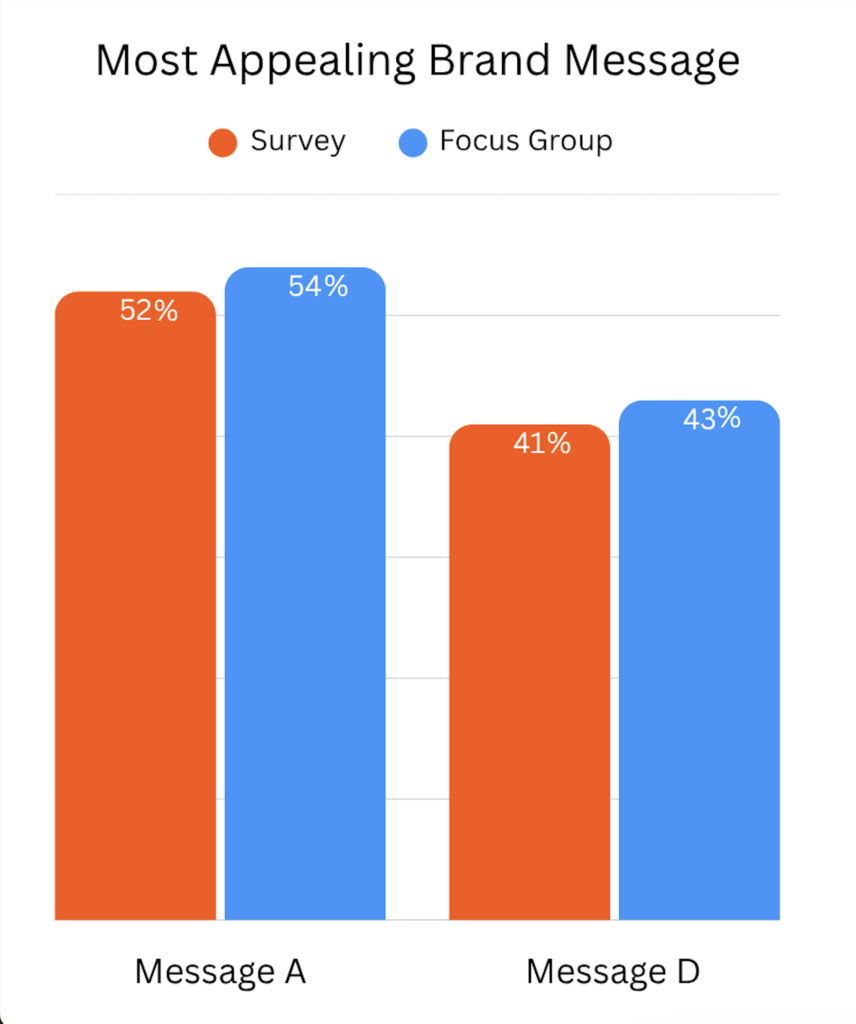
Out of the four brand messages reviewed, the preference was for Message A, with 52% of survey respondents and 54% of focus group participants selecting this as the most appealing message. And on the other hand, Message D was considered the least appealing brand message by 41% of survey respondents and 43% of focus group participants.
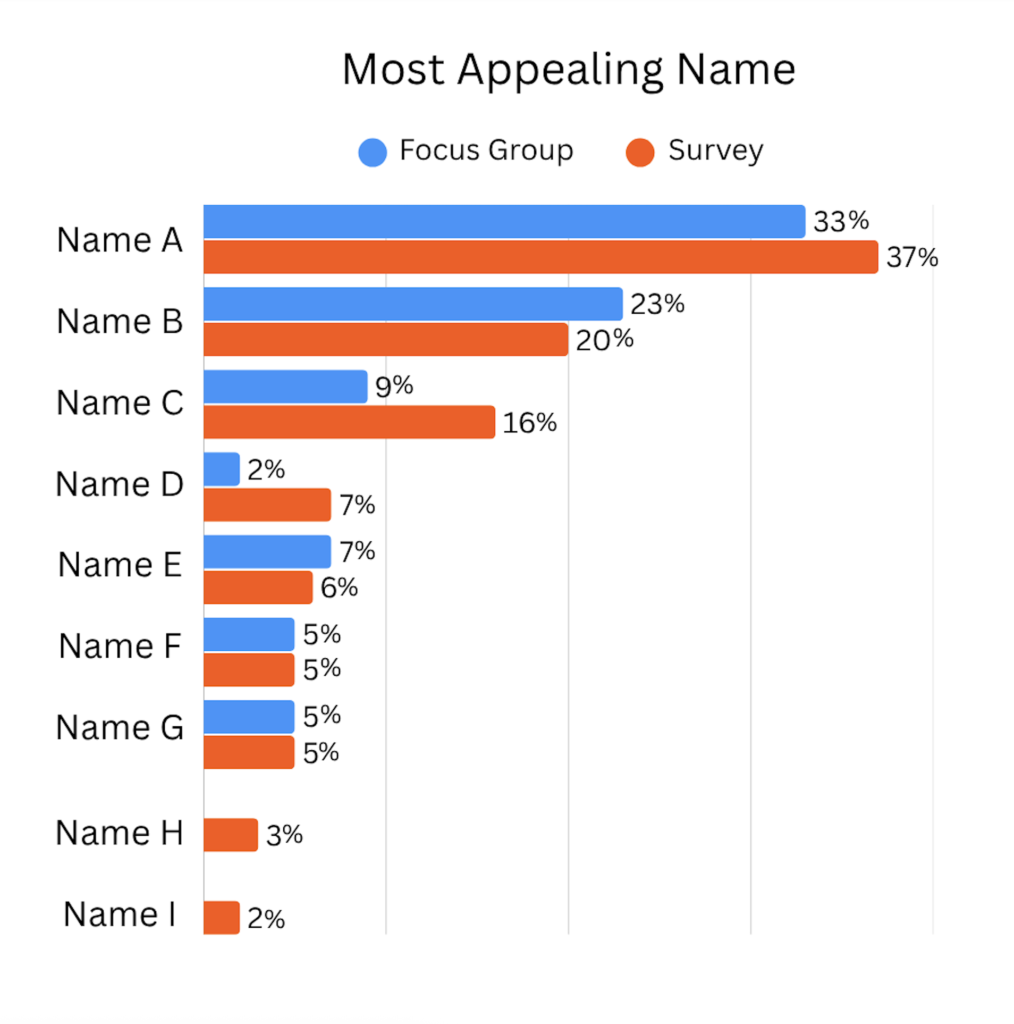
The similarities continued when it came to potential names. We asked participants to identify their favorite of nine possible names for the service line. Not only did focus group participants and survey respondents again select the same preferred name within a few percentage points of each other (37% of survey respondents and 33% of focus group participants preferred Name A) but their order of preference was remarkably consistent, down to their least preferred names.
The Impact
When we brought these results back to the client, they were thrilled. They had strong, consistent data, a good understanding of the relative appeal of their various materials, and confidence in their ability to make a strategic call based on the feedback they received.
And the truth is, they might not have felt so sure about their direction if they’d only gone with one of the two methodologies. The online survey told them how many people found the particular names and messages appealing, and the focus groups helped them understand why certain materials were more and less appealing, and how they could strengthen them to make them even better. Together, they had all the information they needed to brand their service line successfully.
To conclude, can we trust the results of focus groups? Yes. And a study conducted with just focus groups can be informative and impactful for any organization.
But can focus group results be made even more useful when paired with, and used to explain, findings from a quantitative study? Also, yes.
Both qualitative and quantitative methodologies are excellent tools that can be used separately or together to answer the important questions you have about your business and help you make informed, confident decisions when and where it counts.
At Market Street Research, no matter which direction you decide to go in (qual, quant, or both), we’re here to help you feel good about your research.
At Market Street Research, we design and execute complex qualitative and quantitative methodologies in multiple languages.
But having a wide range of research methods is just the start. What sets us apart is how we partner with you to design a tailored blend of qualitative and quantitative methods based on your information needs, timeline, and budget.
To learn more about our approach, contact us for a consultation today.